
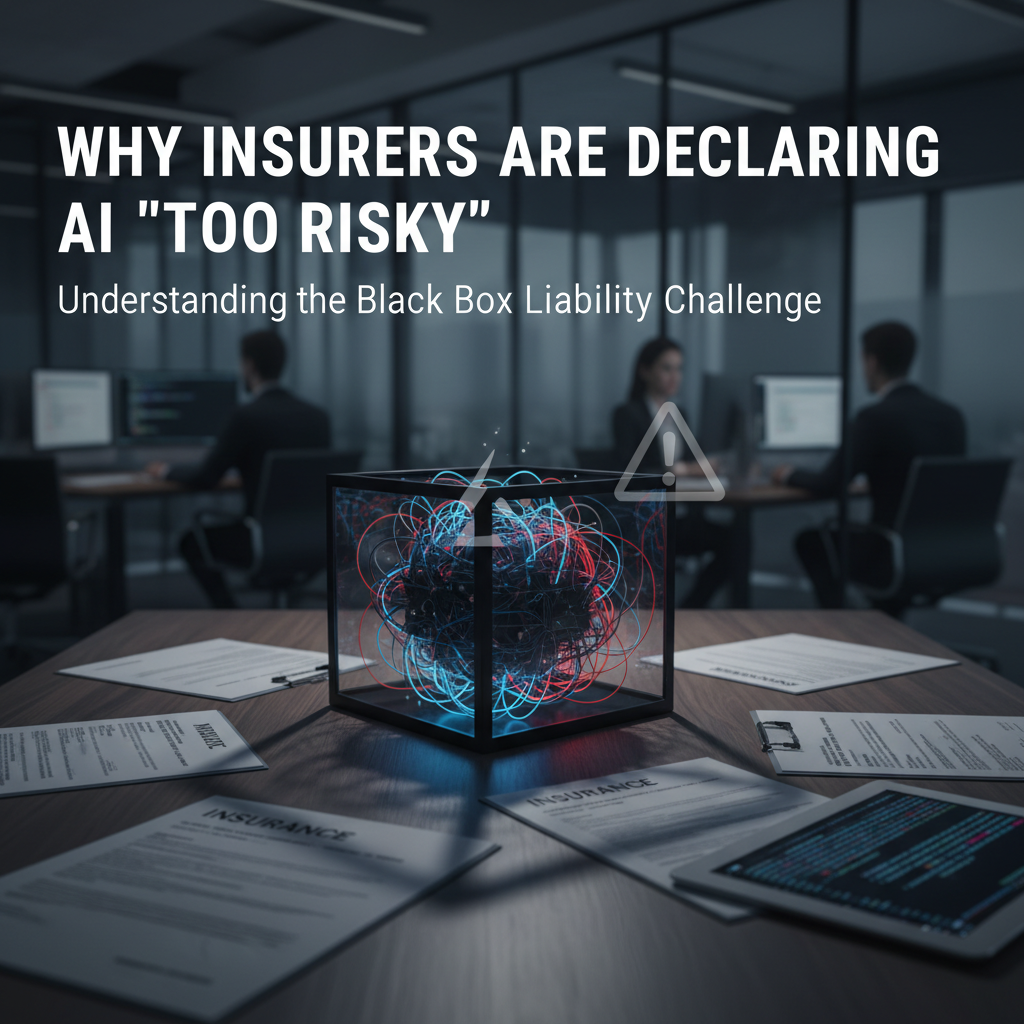
Introduction: The AI Liability Conundrum
The rapid ascent of Artificial Intelligence promises unprecedented innovation, yet it casts a long shadow of unforeseen risks. For insurers, this shadow is darkening into a “black box” problem, making AI liability insurance a challenging, if not impossible, product to offer. This article delves into why major insurance players are increasingly declaring AI “too risky” and what this means for the future of AI adoption.
The “Black Box” Problem: Why Insurers are Hesitant
Major insurance companies express deep concern regarding the inherent unpredictability of AI models. They perceive AI as a “black box,” systems whose intricate internal operations are opaque, rendering it difficult to comprehend how decisions are reached or to foresee potential failures. This lack of visibility presents a fundamental hurdle for traditional risk assessment.
The Unpredictability of AI Models
The core of insurer hesitation lies in the inscrutable nature of many advanced AI systems. Unlike traditional software, where every line of code can be traced, AI’s learning processes often create complex, emergent behaviors that defy simple explanation.
* Lack of Explainability: A significant challenge stems from the lack of transparency in advanced AI systems, particularly deep learning models. Their decision-making processes are often obscure, making it nearly impossible to pinpoint the exact reason behind an error or an unintended outcome. This opacity prevents insurers from understanding the causal links necessary for underwriting risk.
* Systemic Risk: A major fear among industry giants, including Great American, Chubb, and W. R. Berkley, is the potential for widespread AI adoption to trigger “agentic AI mishaps” that could result in “10,000 losses at once” (as highlighted by TechCrunch). Unlike isolated incidents, a single, critical flaw within a widely deployed AI model could precipitate cascading failures and simultaneous claims across multiple industries and jurisdictions. This scenario presents a scale of risk far beyond typical underwriting models.
* Real-world Examples of Unforeseen Liabilities: The theoretical risks of AI are already manifesting in tangible liabilities. For instance, lawsuits have been filed against OpenAI, alleging that manipulative tactics from ChatGPT led to negative mental health effects, including suicide and delusions. This underscores the burgeoning generative AI risk, demonstrating that liabilities extend far beyond mere technical malfunctions to encompass psychological and societal harm. Furthermore, AI systems are implicated in financial losses or misjudgments in critical applications, ranging from automated trading platforms to medical diagnostics, creating a complex web of potential claims that are difficult to quantify.
Current Trends: Insurers Seeking Exclusions
The growing apprehension among insurers is not merely theoretical; it is actively translating into tangible shifts within the insurance industry. This apprehension is compelling major players to reconsider their coverage parameters for AI-related incidents.
The Push for AI Liability Exclusions
Across the globe, major insurance players are actively working to exclude AI-related liabilities from standard corporate insurance policies. This proactive stance means that businesses heavily reliant on AI technologies may increasingly find themselves without adequate coverage for critical, yet emerging, risks. This trend forces companies to confront a significant gap in their risk mitigation strategies.
* Names to Watch: Companies like Great American, Chubb, and W. R. Berkley have been particularly vocal about their concerns and are at the forefront of efforts to implement such exclusions, reflecting a broader industry sentiment. While AIG has publicly stated it has no immediate plans for widespread AI exclusions, the overall trajectory of the market suggests a cautious approach is becoming the norm. The industry’s move towards exclusions is a direct response to the unknown and potentially catastrophic scale of generative AI risk and other AI-specific perils.
* Addressing Regulatory Challenges: The absence of clear legal frameworks and consistent industry standards for AI accountability further complicates the landscape for insurers. This regulatory vacuum makes it exceptionally difficult to define the scope of risk, assign responsibility, or calculate premiums. Consequently, insurers are gravitating towards exclusion rather than attempting to underwrite risks within such an ambiguous environment. The lack of a robust regulatory baseline creates significant regulatory challenges that impede the development of viable AI liability insurance products.
Types of AI Risks Driving Exclusions
The breadth of potential harms originating from AI systems is vast, each contributing to insurers’ reluctance to offer coverage. These risks often intersect and compound, making comprehensive coverage a complex proposition.
* Algorithmic Bias: This risk arises from discriminatory outcomes produced by AI models trained on biased data or designed with inherent prejudices. Such biases can lead to unfair treatment in areas like hiring, credit scoring, or criminal justice, triggering substantial legal and reputational damages.
* Data Privacy Breaches: AI systems frequently process and store vast quantities of sensitive data, thereby elevating the potential for costly privacy violations. Machine learning algorithms, if not properly secured, can become vectors for data breaches or misuse, exposing companies to significant fines and consumer backlash.
* Cybersecurity Vulnerabilities: AI acts as a dual-edged sword in cybersecurity; while it can enhance defense mechanisms, it also introduces new attack vectors. AI-powered malware, sophisticated phishing, and autonomous cyberattacks represent novel threats that traditional cybersecurity insurance policies may not adequately cover.
* Generative AI Risk: Beyond direct technical failures, generative AI poses unique and complex risks. These include the proliferation of misinformation, deepfakes, and copyright infringement through generated content. As evidenced by recent lawsuits mentioned previously, these systems can also contribute to psychological manipulation, opening up entirely new categories of liability that are difficult to quantify or predict. This category of risk is particularly concerning due to its rapid evolution and the broad scope of potential societal impact.
Insights: The Imperative for Robust AI Risk Management
For businesses leveraging Artificial Intelligence, the insurance industry’s evolving stance serves as an urgent call to action. It underscores the critical need for developing and implementing comprehensive AI risk management strategies that go beyond traditional IT risk assessments. Proactive measures are no longer optional but essential for sustainable innovation and securing future insurability.
Proactive Risk Mitigation for Businesses
Businesses must adopt a proactive and multifaceted approach to mitigate AI risks, embedding these practices into the very fabric of their AI development and deployment lifecycle. This involves a shift towards more transparent, controllable, and accountable AI systems.
Embracing Explainable AI (XAI): Prioritizing the development and deployment of AI models that offer transparency into their decision-making processes can significantly demystify the “black box” phenomenon. XAI approaches allow stakeholders to understand why* an AI arrived at a particular conclusion, facilitating easier identification of errors, biases, and vulnerabilities. This enhanced understanding is crucial for building trust, demonstrating accountability, and potentially making systems more comprehensible for future underwriting.
Rigorous Testing and Validation: Implementing extensive and continuous testing protocols is paramount. This includes not only standard validation but also adversarial testing to probe the AI’s robustness against malicious inputs or unexpected scenarios. Identifying and mitigating potential failure points before* deployment can prevent costly incidents, safeguard reputations, and demonstrate a commitment to safety. This rigorous approach forms a cornerstone of effective AI risk management.
* Developing Strong Corporate AI Policies: Establishing clear, internal guidelines for AI development, deployment, monitoring, and accountability is not just good practice, it’s crucial. These corporate AI policies should encompass every stage of the AI lifecycle, defining roles, responsibilities, and ethical considerations.
* Data Governance: Ensuring data quality, ethical sourcing, and strict privacy compliance is fundamental. Biased or compromised data can lead to discriminatory outcomes and significant legal liabilities, directly contributing to generative AI risk if used in large language models.
* Model Monitoring: Continuous oversight of AI performance after deployment is essential to detect drift, anomalous behavior, or unintended consequences. Proactive monitoring allows for timely intervention and recalibration, preventing minor issues from escalating into major incidents.
* Human Oversight: Maintaining human-in-the-loop processes for critical AI decisions provides a crucial safety net. Human review and override capabilities ensure that ultimate accountability remains with human operators, particularly in high-stakes applications.
Making AI More Insurable
Demonstrating robust corporate AI policies and comprehensive AI risk management frameworks can significantly alter a business’s risk profile from an insurer’s perspective. Companies that can provide clear evidence of these practices will likely be seen as more attractive, or at least less risky, clients. This proactive approach could potentially open doors to future AI liability insurance products. The New York Responsible AI Safety and Education (RAISE) Act, for example, which requires large AI developers to follow safety rules and report incidents, hints at future regulatory challenges and environments that could provide clearer parameters for insurance. Adhering to such emerging standards will be key to proving a commitment to responsible AI.
Forecast: The Future of AI Liability and Insurance
The current climate, characterized by insurer apprehension and evolving risks, signals a significant shift in how AI risks will be managed, mitigated, and potentially insured in the coming years. The future landscape for AI liability insurance will likely diverge significantly from traditional coverage models.
The Emergence of Specialized AI Insurance
Given the unique and complex challenges posed by AI, a new class of specialized AI liability insurance products is likely to emerge. These will be distinct from generic corporate policies and tailored specifically to the nuances of AI risk. This new category might involve several key characteristics:
* Higher Premiums Due to Inherent Uncertainties: The intrinsic unpredictability and potential for widespread, systemic losses associated with AI will likely translate into significantly higher premiums compared to traditional liability insurance. Insurers will factor in the higher risk profile and the difficulty of accurately assessing long-term liabilities.
* More Specific, Often Narrower, Coverage Terms: Unlike broad corporate policies, specialized AI insurance is expected to feature highly specific and often narrower coverage terms. Policies may differentiate between algorithmic bias, data privacy breaches stemming from AI, or specific types of generative AI risk, requiring businesses to understand precisely what is covered and what is not.
* Requirements for Rigorous Third-Party Audits and Certifications of AI Systems: To gain any form of coverage, businesses may be mandated to undergo rigorous third-party audits and obtain certifications for their AI systems. These audits would verify the implementation of strong AI risk management practices, adherence to ethical guidelines, and robust corporate AI policies, providing insurers with a clearer, albeit still evolving, baseline for risk.
Regulatory Landscape and Industry Standards
The global regulatory landscape for AI is rapidly evolving, driven by concerns over safety, ethics, and accountability.
* Expect increased regulatory challenges globally, mirroring initiatives like the RAISE Act in the United States and the EU AI Act. These regulations will push for greater AI accountability and safety, requiring businesses to adhere to stricter guidelines regarding transparency, data governance, and risk assessment. Such frameworks, while presenting compliance hurdles, could ultimately provide clearer parameters for insurers to develop viable products.
* Industry consortia and standards bodies will play an increasingly vital role in developing best practices for AI governance, transparency, and AI risk management. These evolving standards, born from collaborative efforts, could, in turn, inform and standardize future AI liability insurance products, offering a more consistent benchmark for risk assessment.
* The focus will undeniably shift towards auditable AI development lifecycles. This means mandating comprehensive documentation of design choices, ethical considerations, training data sources, and validation processes. Such documentation will be essential not only for regulatory compliance but also for providing insurers with the necessary transparency to assess and price risk.
Business Imperatives
In this evolving environment, businesses leveraging AI face clear imperatives.
* Companies must integrate AI ethics, safety, and accountability into their core business strategy, viewing them as competitive advantages rather than mere compliance burdens.
* Investment in specialized AI governance tools and expertise will become non-negotiable. This includes hiring AI ethicists, risk managers, and legal experts to navigate the complex landscape.
* Proactive engagement with emerging regulations and industry standards will be key to navigating future AI liability insurance landscapes, ensuring operational continuity and fostering public trust.
Securing Your AI Future
Insurers’ reluctance to cover AI liabilities is a stark wake-up call for businesses across all sectors. The “black box” challenge highlights the critical need for greater transparency, robust AI risk management, and well-defined corporate AI policies. As AI continues its rapid evolution, understanding and proactively addressing its inherent risks will not just be a matter of compliance – it will be a cornerstone of sustainable innovation and a prerequisite for securing crucial AI liability insurance.
—
Ready to fortify your AI strategy against emerging risks? Learn how to implement comprehensive AI risk management and develop resilient corporate AI policies to navigate the complex landscape of AI liability insurance.